Store your solar Spend less at the evening peak. Stay powered when the grid isn't.
Tech Solar designs, builds and maintains battery energy storage systems (BESS) that pair with rooftop and ground-mount solar for factories, commercial sites, EV depots and grid-scale projects across India.
Much of a factory's cost pressure sits outside the hours the sun is shining. A battery closes that gap.
01
Time-of-day savings
Time-of-day tariffs reward midday consumption and penalise the evening peak. Store cheap solar energy and use it when grid power costs the most.
02
Policy is moving to storage
Maharashtra’s 2025-26 Renewable Energy and Energy Storage Policy points larger new renewable projects towards integrated storage from April 2026. Design for it now.
03
Power through outages
With DG, PV and BESS synchronisation in place, solar can keep supporting your plant when the grid drops, and diesel burn falls.
04
No wasted solar
On zero-export sites, surplus midday generation has nowhere to go. A battery absorbs it on low-load days instead of curtailing it.
Where we deploy
Storage built around your use case
Every site has a different load curve, tariff and constraint. We size the battery to the problem, not to a catalogue.
Add storage to new or existing plants to firm output and meet evolving state requirements.
Retrofit or co-build
Sizing and financial modelling
Approvals and liaisoning
Product range
From a single cabinet to a grid-scale block
Four size classes cover most projects. Each is configured with the battery, PCS and EMS your site needs, and every size can be paired with solar.
Small C&I
Cabinet BESS
100 - 500 kWh
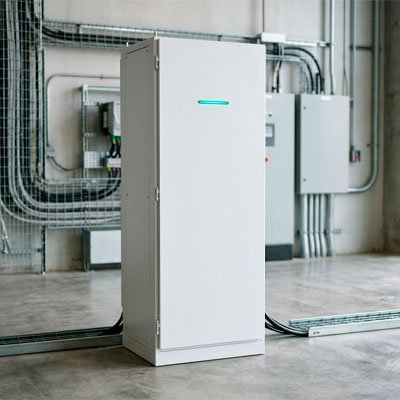
Indoor or outdoor cabinets for factories, offices, hospitals and commercial buildings. Fits behind the meter beside an existing solar plant.
Typical power
50 – 250 kW
Format
Rack / cabinet
Best for
Peak shaving, DG cut
Mid C&I
Containerised BESS
0.5 - 5 MWh
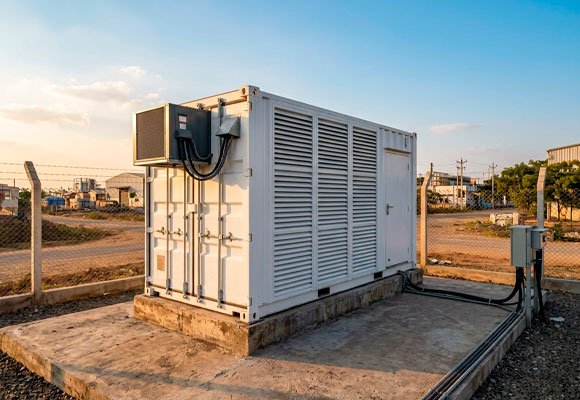
Plug-and-play containers for large factories, industrial parks and EV depots, with HVAC, fire detection and protection built in.
Typical power
250 kW – 2.5 MW
Format
10 / 20 ft container
Best for
Depots, industry, hybrids
Utility
DC block
5 - 10 MWh
High-density, liquid-cooled 20 ft LFP blocks for utility and industrial-scale storage. Blocks pair with PCS units sized to your discharge duration.
Typical block
~5 MWh per 20 ft
Cooling
Liquid cooled
Best for
Peak shaving, DG cut
Grid-scale
Multi-block plants
40 MWh +
Blocks, PCS, transformers and the pooling substation engineered as a single plant, for utilities, state agencies and large developers.
Typical power
5 – 200 MW
Duration
2 – 8 hours
Best for
Grid support, ToD shift
Sizes shown are indicative ranges. Exact capacity, power, dimensions, weight and lead time depend on the battery and PCS selected for your project. Send us your load data for a specific configuration.
In the field
Storage that looks like it belongs on site
A few of the system types we design and install.
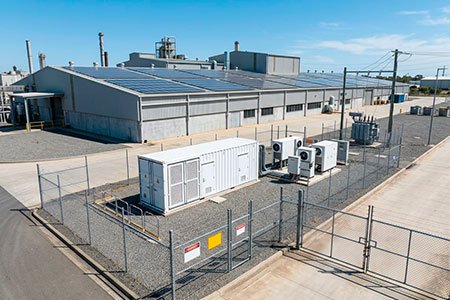
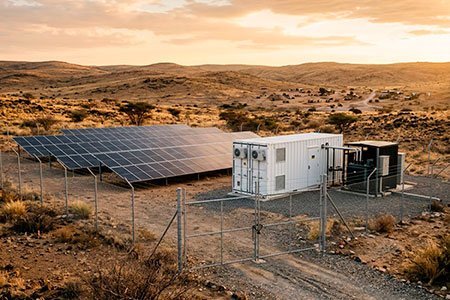
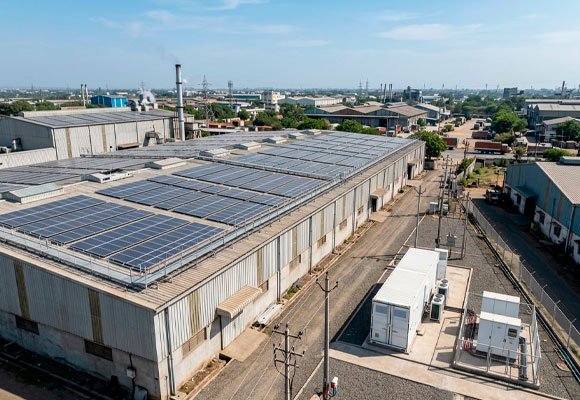
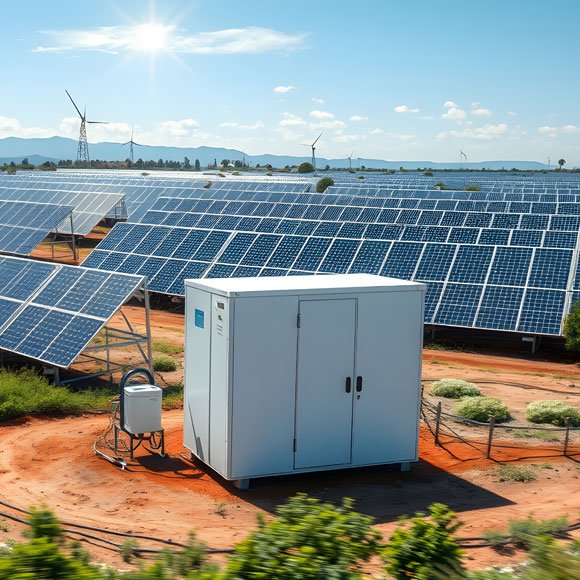
Solar + BESS at an industrial site
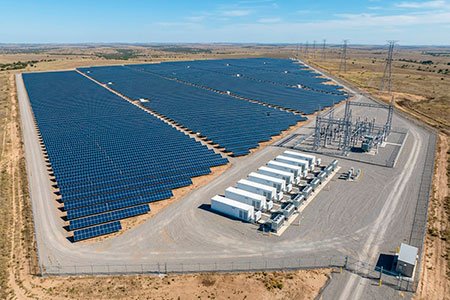
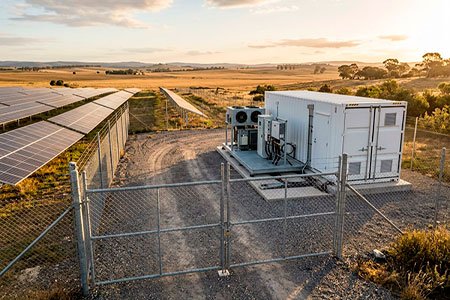
Containerised BESS
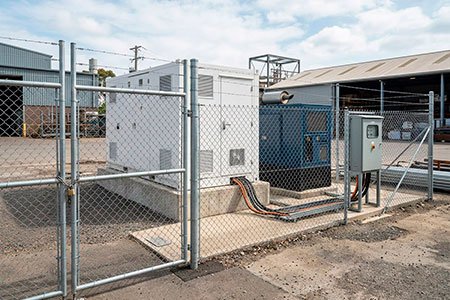
Cabinet installation
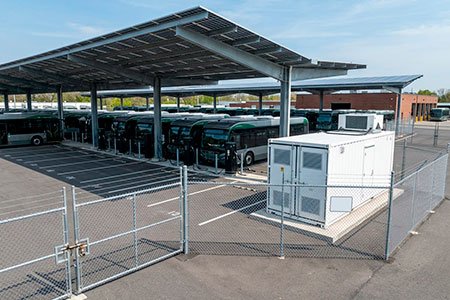
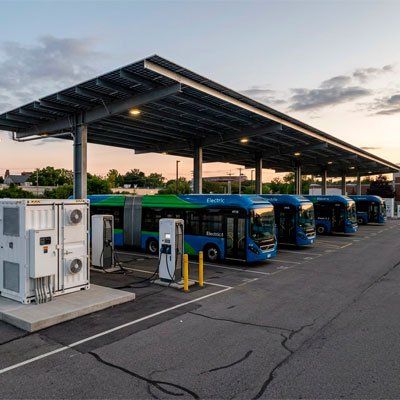
EV depot with storage
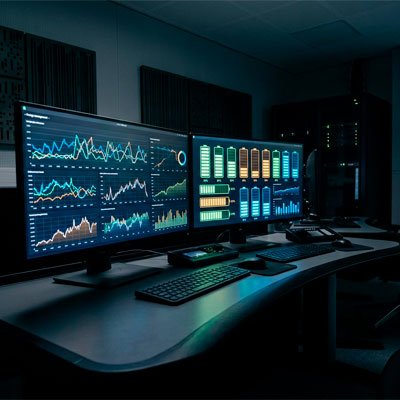
EMS monitoring
System design
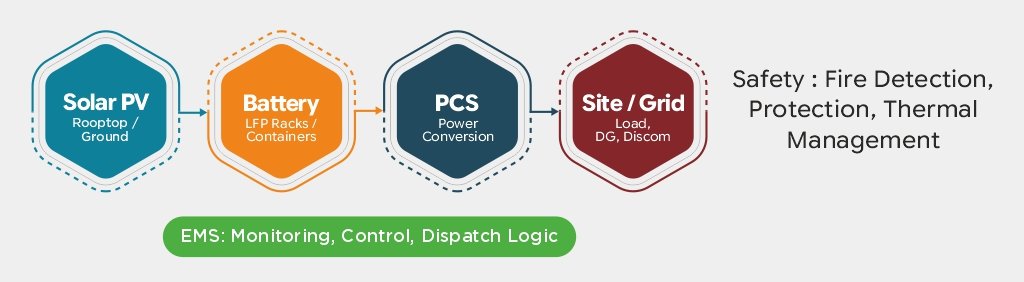
One integrated system, engineered end to end
We choose the architecture that fits your project economics, then integrate every layer so it performs as one system.
Lithium iron phosphate (LFP) batteries lose usable capacity gradually with cycling and age. That is normal, and we plan for it from day one.
Warranty
OEM warranty on battery, PCS and EMS, with terms defined up front.
Augmentation
Add battery stacks over time to restore original usable capacity, while reusing the PCS, racks, protection and balance of system.
Modelled honestly
State of health and round-trip efficiency are modelled across the system life, not assumed flat.
Repowering ready
Electrical infrastructure is designed to outlast the first battery.
Questions
Frequently asked
What is a BESS, in simple terms?
A battery energy storage system stores electricity, from your solar plant or the grid, and releases it when you need it. It is made up of battery racks, a power conversion system (PCS), an energy management system (EMS) and safety systems.
How is a BESS sized?
We start from your load data and tariff, then test combinations of power (kW or MW) and energy (kWh or MWh) to find the best balance of savings, cost and battery life. Oversizing wastes capital; undersizing misses savings.
Can I add a battery to an existing solar plant?
Often yes. Depending on your inverter and site, we can retrofit an AC-coupled battery or redesign for a DC-coupled setup. We review your plant and approvals first.
What happens to the battery after the warranty?
The battery keeps working with gradually reduced capacity. If you want the original usable capacity back, we add battery stacks and reuse the PCS, racks and other balance of system, so you do not replace the whole system.
Is a BESS safe?
Modern LFP systems are designed with cell-level monitoring, thermal management, fire detection and electrical protection. We specify safety requirements against your site layout and applicable standards.
Do you handle approvals and insurance?
We support DISCOM liaisoning and can help arrange project insurance, including cover for storage-related risks.
Savings, payback and performance vary by site. We share a modelled estimate with clear assumptions before you commit.
Find out what storage can save your site
Send us a recent electricity bill and your solar details. We will come back with a first-pass sizing and savings view.